What My Daughter Taught Me About AI Literacy and Critical Thinking
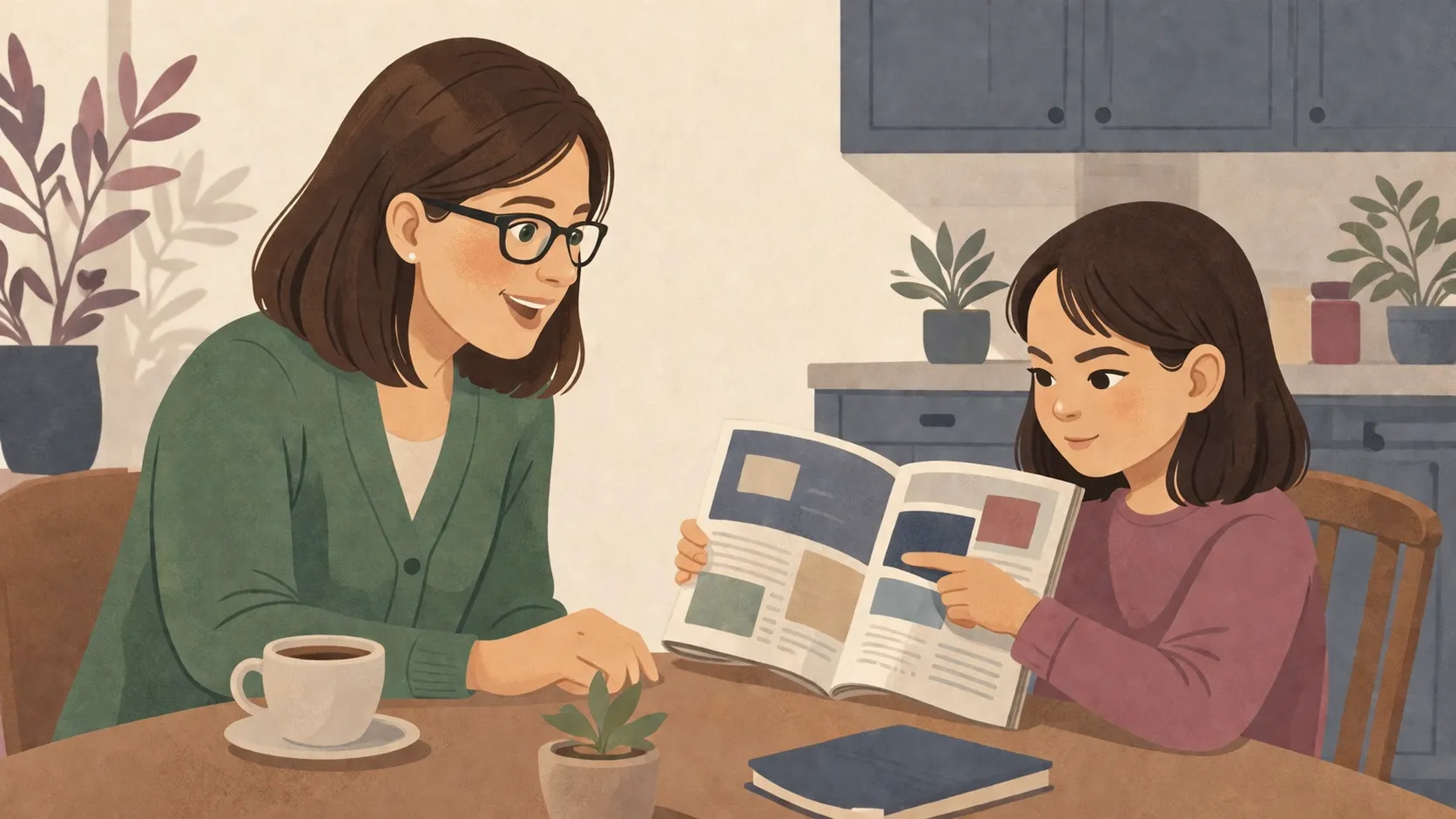
My daughter spotted something suspicious before I had finished my coffee. What she did next is exactly what higher education needs to teach.
TL;DR
- My daughter Emily spotted an AI-generated image in her magazine before I had finished my coffee. She circled it, brought it to me, and explained exactly why she thought it was fake. That's AI literacy in action.
- AI literacy is not about banning tools or teaching students to fear technology. It's about teaching them to ask better questions. To notice what doesn't fit. To trust their instincts and then verify.
- The skills Emily used are the same skills we need to teach in higher education. Pattern recognition, critical evaluation, and the confidence to say "something's not right here" even when everyone else seems fine with it.
- We are not preparing students for a world where AI might show up. We are preparing them for a world where AI is already embedded in everything they read, watch, and trust. The question is whether we are teaching them to notice.
- AI literacy is formation work. It's teaching students to think critically, question confidently, and engage with technology as informed humans, not passive consumers. That's the work higher education was built to do.
My daughter Emily recently got a subscription to The Week Junior, a weekly magazine for kids that covers current events in an age-appropriate way. She loves to read. She loves to learn. She has had the magazine for only a few days and has already read it four times. She took it to school to read at recess.
Emily is the kind of kid who pays attention. So when she circled a photo in the magazine and brought it to me with a very specific concern, I was not entirely surprised. But I was completely proud.
CRITICAL THINKING IN ACTION
A Magazine, A Gorilla Hand, and a Nine-Year-Old Who Was Not Convinced
[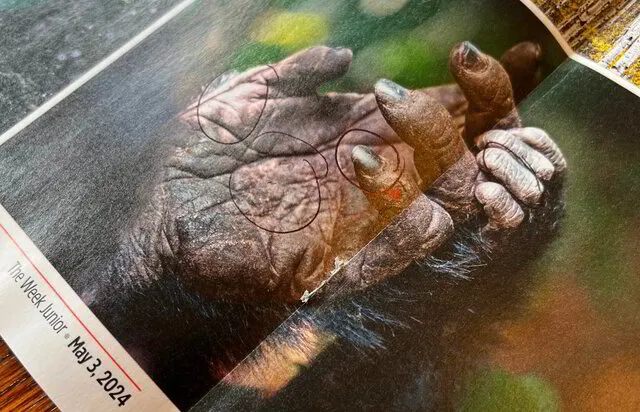]()
The photo in question was labeled as a gorilla hand. Emily looked at it, looked at it again, and decided something was off.
She had three specific observations.
First, it looked like someone had painted a human hand. Second, the lighting looked strange, not the way light falls naturally on skin or fur. Third, the nails were too glossy. Real gorilla hands do not look like that.
She circled the photo and came to find me. "Mom, something is wrong with this photo. They say it is a gorilla hand, but I do not think it is."
Here is the thing: it is a real photo. The image was taken by photographer Michael Stavrakakis. Emily was wrong about the conclusion but completely right about the process.
She looked carefully. She identified specific discrepancies. She formed a hypothesis. She brought it to someone she trusted for further investigation. And when we looked it up together after school, she learned something new, which she is always up for.
That is not a mistake. That is exactly how critical thinking is supposed to work.
SEEING IS POWERFUL EVEN WHEN WE KNOW IT IS NOT REAL
She Was Right to Question It
Let me be clear about something. Emily being wrong about this particular photo is not the point.
The point is that she questioned it at all.
We are living in a moment where AI can generate photorealistic images of things that never happened. Deepfake videos of real people saying things they never said. Written content that mimics human voice so closely that no detection tool can reliably catch it. The ability to fabricate convincing evidence of almost anything is no longer the exclusive domain of nation-state actors with sophisticated technology. It is available to anyone with a smartphone and a free account.
In that world, the child who looks at a photo and says "something is wrong here" is ahead of most adults.
[]()
Emily's instinct to question the image before accepting it as real is the exact cognitive habit that media researchers, AI ethicists, and educators have been trying to build in people for years. She did it naturally, at the kitchen table, before school, because she had been raised in an environment where questioning things is not rude, it is responsible.
That environment did not happen by accident. It was built intentionally. And that is exactly the challenge sitting in front of every higher education leader right now.
Is your institution building critical thinkers or assuming they arrive that way?
Most leaders we talk to know the gap exists. They just have not had time to close it.
You do not need to rebuild your curriculum from scratch. You need a strategic partner who knows where to start.
[Let's talk about where your institution stands →](/contact)
Here is what closing it actually looks like:
- A curriculum audit that shows you exactly where critical thinking is and is not being taught
- Faculty development that builds AI literacy into existing courses without adding new ones
- Student-facing frameworks that make skepticism feel safe rather than threatening
- Leadership language that connects AI literacy to your institutional mission
IT IS NOT JUST A PHOTOGRAPH
Why This Moment Matters More Than the Photo
[]()
As a mom, I was proud. As a media professor and AI strategist, I was paying close attention to something much larger than a single photo in a single magazine.
We are approaching a moment, and in many ways, we are already there, where the ability to detect AI-generated content with tools alone is functionally impossible. The generation of technology moves faster than the detection technology. That gap will only widen.
Which means the most important question is not "what tool do we use to catch AI content?"
The most important question is "what kind of people are we building?"
Emily did not use a tool. She used her eyes, her prior knowledge, her instinct for what looks right, and her willingness to say out loud that something seemed wrong. She used judgment.
Judgment is not downloaded. It is developed. It is formed over time through practice, through exposure, through communities that reward the habit of questioning rather than punishing it. That is a formation challenge. And formation has always been the deepest work of higher education.
THE FIVE-STEP PROCESS FOR DISCERNMENT
What Higher Education Can Learn From a Child With a Magazine
Emily's process that morning followed a framework that every institution should be teaching explicitly:
She observed carefully rather than accepting the image at face value.
She identified specific evidence for her concern rather than just feeling vaguely uncomfortable.
She formed a hypothesis based on that evidence.
She sought a second opinion from a trusted source rather than either dismissing her concern or acting on it impulsively.
She remained open to being wrong and used the experience as a learning opportunity.
That five-step process is not complicated. But it does not happen automatically. It happens because someone, a parent, a teacher, a mentor, an institution, has modeled it, rewarded it, and made it a cultural expectation. Higher education has the infrastructure to do this at scale. The question is whether it is using that infrastructure intentionally or leaving critical thinking to chance.
Right now, most institutions are leaving it to chance. Students arrive with wildly varying levels of media literacy. Curricula address it inconsistently, if at all. Faculty are not always equipped to model it themselves, particularly when it comes to AI-generated content, which moves faster than most professional development cycles.
The result is graduates who can operate AI tools but cannot always evaluate what those tools produce. That is a formation gap with real consequences for individuals, for institutions, and for the civic fabric that those graduates will help shape.
PRACTICE IS KEY
Critical Thinking Is Not a Trait. It Is a Practice.
This is the part I want higher education leaders to sit with.
We often talk about critical thinking as if it is something students either have or do not have. A trait. A personality characteristic. Something you can assess on an admissions rubric.
It is not. It is a practice. And like all practices, it requires repetition, modeling, feedback, and a community that takes it seriously.
Emily did not wake up one morning with the ability to question a photo in a magazine. She developed it over time in an environment where questioning things was normal, where being curious was celebrated, and where being wrong was not shameful as long as you were thinking carefully.
[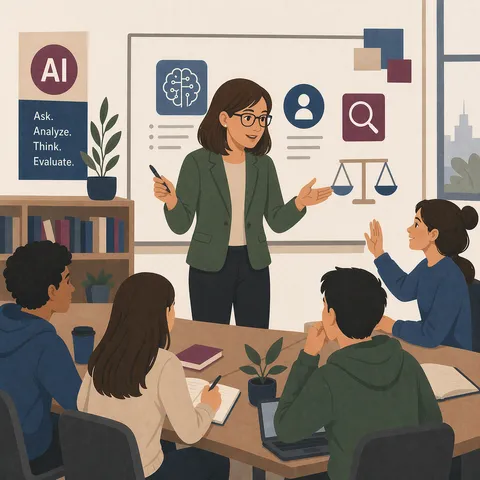]()
Institutions can build that environment. In fact, they are uniquely positioned to do so at a scale no family or individual can match.
But it requires intention. It requires curriculum design that embeds critical evaluation across disciplines rather than siloing it in a single media literacy course. It requires faculty who model intellectual humility alongside content expertise. It requires leadership that takes formation seriously as an institutional outcome — not just graduation rates and job placement.
It requires, in other words, exactly what higher education was built to do. The urgency is new. The work is not.
Your institution doesn't need one AI expert.
You need a network of AI First Responders.
Stop treating AI adoption like a project. Start building a culture of confidence.
AI First Responder is the credential that changes that.
It's not about IT. It's about people. It's about equipping faculty, staff, and leadership to respond with clarity, confidence, and integrity when colleagues need guidance. This is the work that happens in offices, in hallways, during advising appointments, and at faculty meetings.
[Learn about the AI First Responder program →](/ai-first-responder)
AI First Responders do:
- Normalize confusion instead of escalating fear
- Help colleagues think with AI rather than hide it
- Model ethical, transparent AI use
- Know when to reassure and when to escalate
They don't:
- Police or interrogate colleagues
- Make assumptions about intent
- Make colleagues feel ashamed for asking
- Override institutional guidelines
This isn't a one-time workshop. It's a structured, practice-based credential built for the real work of institutional leadership.
What Higher Ed Leaders Can Do Right Now
- Audit where critical thinking is explicitly taught in your curriculum.
Not where it is assumed or hoped for. Where it is actually taught, modeled, assessed, and reinforced. You may find the gaps are larger than you expected.
- Build media and AI literacy into orientation — not just electives.
Every student who arrives on your campus is already living in an AI-saturated media environment. Orientation is your first opportunity to give them a framework for navigating it. Do not waste it on logistics.
- Train faculty to model intellectual humility alongside content expertise.
Students learn as much from watching how their professors handle uncertainty as they do from course content. Faculty who say "I am not sure, let us find out together" are teaching critical thinking in real time.
- Create institutional permission to question.
Students who come from environments where questioning authority figures is dangerous do not automatically feel safe questioning information sources either. Institutional culture matters. Build one where skepticism is welcomed.
- Connect AI literacy to your institutional mission explicitly.
Critical thinking in the age of AI is not a technology issue. It is a mission issue. Frame it that way in your strategic planning, your faculty development, and your student learning outcomes.
Emily will keep questioning things. She already has the next issue of The Week Junior. If you are working to build that same habit of mind across your institution and you are not sure where to start, that is exactly the work I do.
[Let's chat](/contact)
COMMON QUESTIONS
Frequently Asked Questions
Why does critical thinking matter more now that AI can generate content?
Because AI-generated content is becoming increasingly indistinguishable from human-created content, the ability to evaluate sources, question evidence, and form independent judgments is more important than it has ever been. Detection tools exist, but are unreliable and are consistently outpaced by generation technology. The more durable solution is to develop people with the habits of mind to navigate uncertainty with judgment rather than panic.
What role does family and early education play in building AI literacy?
A significant one. As Emily's story illustrates, the habits of mind that support AI literacy — questioning, observing carefully, seeking evidence, remaining open to being wrong — are developed over time in environments that model and reward them. Higher education receives students who arrive with widely varying foundations. That is precisely why intentional institutional design matters: it cannot assume students arrive ready and it cannot leave formation entirely to chance.
What is the difference between teaching critical thinking and forming critical thinkers?
Teaching critical thinking typically refers to introducing skills and frameworks in a classroom setting. Forming critical thinkers is a deeper institutional process that builds habits of mind over time through repeated practice, cultural reinforcement, and modeling by faculty, staff, and leadership. Skills can be introduced in a workshop. Formation requires sustained community and intentional institutional design.
How do I build AI literacy into the curriculum without adding another course?
The most effective approach is integration rather than addition. AI literacy competencies — source evaluation, understanding of how AI generates content, recognition of AI limitations — can be embedded into existing courses across disciplines. A history course can address AI-generated historical imagery. A communications course can examine AI-written content. A business course can evaluate AI-generated market analysis. The goal is to make critical evaluation of AI content a shared expectation across the curriculum rather than one department's responsibility.

Let's talk.
If you are leading an institution through this moment and you are not sure where to start, that is exactly what I do.
[Request a consultation]()
Sarah Gibson is the former Director of the School of Communication and Faculty Fellow for AI at Lipscomb University and founder of PivotPoint EDU. She is also the co-creator of the AI and the Kid podcast, which she hosts with her daughter Emily. She helps higher education institutions and nonprofits move from AI anxiety to AI strategy with clarity and confidence. Learn more.
Comment 0 Comments JD